The 1981 half dollar value does not rise because of every odd mark, weak letter, or strange-looking digit. Most 1981 Kennedy half dollars are normal coins. The real split starts when the coin shows a major mint error, a recognized variety, or a feature that collectors actually track and pay for. That is the point of this article: separate the useful finds from the noise.
Why 1981 Half Dollars Get Overcalled
This date creates a lot of confusion. Some collectors see a flat mint mark, a strange 9, or a soft area in the design and assume they found a rare error. Most of the time, they did not. The 1981 half dollar has a few real paths to premium value, but it also has many small traits that look unusual and still stay minor.
That is why this date works better as a sorting exercise than as a hype story. Some pieces deserve a second look. Many do not.
| Issue | What Collectors Usually Check |
| 1981-P | Major errors, odd mint mark shape, date quirks |
| 1981-D | Doubling claims, strike quality, and major errors |
| 1981-S Type I Proof | Filled or less clear S mint mark |
| 1981-S Type II Proof | Clearer S mint mark, stronger collector demand |
The first thing to do is to separate the three groups:
- Major errors
- Minor varieties
- Overcalled oddities
That keeps the article practical. It also keeps expectations realistic.
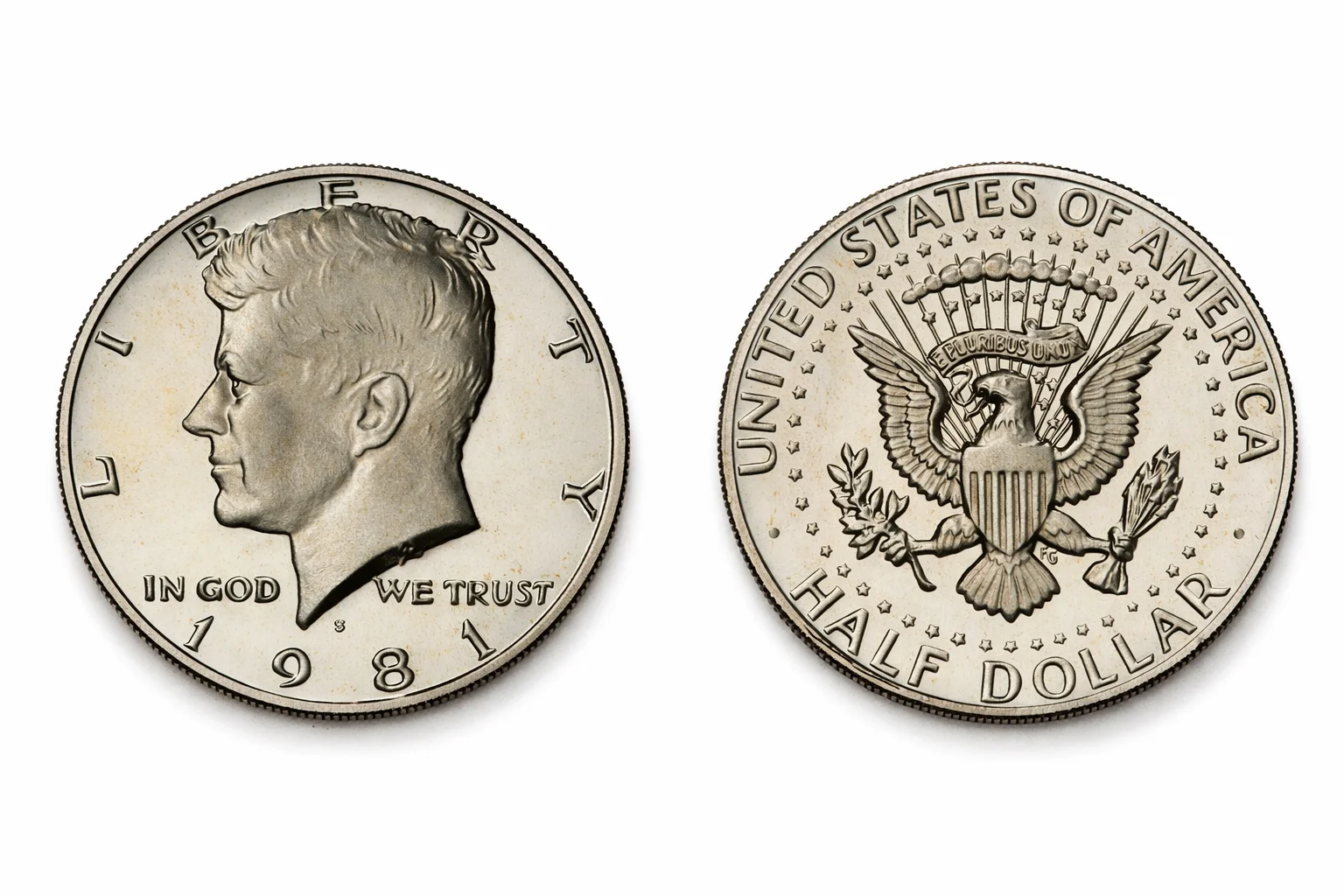
Which 1981 Errors Really Matter
A useful 1981 error usually has one of these traits:
- Clear visual impact
- Easy attribution
- Obvious mint-made origin
- Better resale potential
- Stronger collector interest
A wrong planchet error fits this group. A visible struck-through error can fit too. A proof mint mark variety also matters, even if it is not a dramatic production mistake. On the other hand, a weak letter, a small raised bubble, or a strange date shape often stays in the lower tier.
The key idea is simple: the market rewards errors that are clear, repeatable, or dramatic. It usually ignores small features that need too much explanation.
1981-P Struck on Quarter Planchet
This is one of the strongest 1981 half dollar errors to know. A half dollar struck on a quarter blank is not a small curiosity. It is a major wrong-planchet error.
The coin is struck on a smaller piece of metal than it should be. That changes the whole look:
- The design appears crowded
- Parts of the lettering may be missing
- The rim can look incomplete
- The diameter is wrong for a half dollar
This is the kind of error that gets real attention because the base blank itself is wrong. That puts it in a different class from weak strike or minor die fill. It is also easier to explain and easier to sell once authenticated.
A reported 1981-P half dollar struck on a quarter planchet has been valued at above $860. That does not mean every small-looking 1981 half is valuable. It means this specific error type has real market weight when it is genuine.
The main mistake here is misreading damage as a wrong planchet. A worn edge, filing, or damage can distort the coin. Weight and diameter matter. Authentication matters even more.
Struck-Through Errors on 1981-P and 1981-D
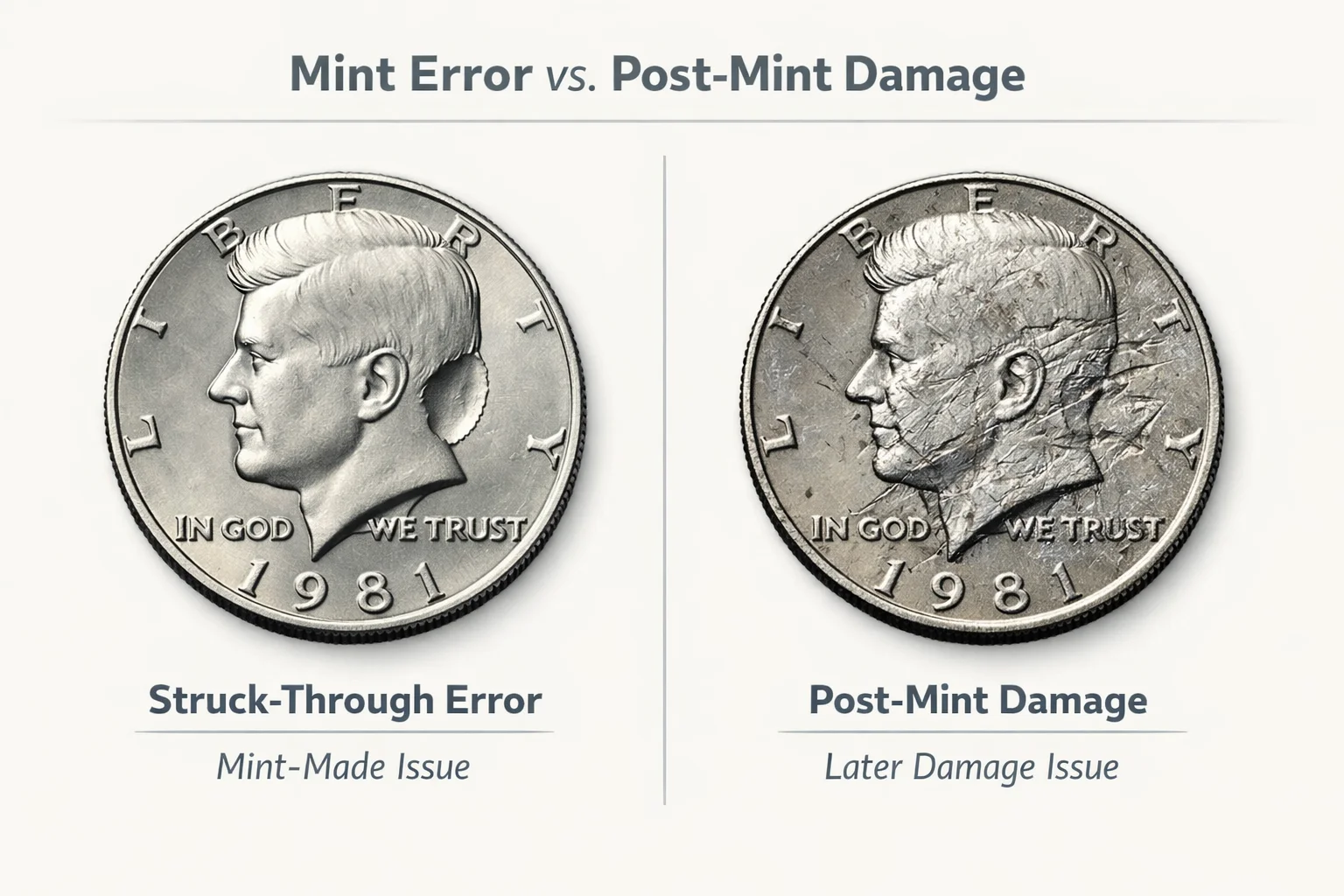
This is the next group worth real attention. A struck-through error happens when grease, lint, debris, or another foreign material gets between the die and the planchet during the strike. The result is missing detail, a recessed area, or a soft patch where the design should be stronger.
These errors can matter when the effect is clear enough to see without guessing.
What usually helps:
- A visible indentation
- Missing detail in a key area
- Smooth and natural-looking disruption
- No signs of later damage
What usually weakens the case:
- Rough scraping
- Random surface marks
- Tiny soft spots
- Damage after the strike
For 1981 half dollars, stronger struck-through errors can bring roughly $80 to $150 or more, depending on size, location, and eye appeal. Small examples exist, but they do not all deserve a premium. The cleaner the error, the better the chance that collectors will care.
1981-D Doubling Claims
This is where many collectors lose discipline. Reports of doubling on 1981-D half dollars appear often, especially in the hair or in “In God We Trust.” Some pieces may show something interesting. Many others show machine doubling, strike softness, or lighting effects that get overstated.
That is why this section needs a practical approach.
When a doubling claim appears, look for these points:
- Is the spread clear and repeatable?
- Does it look raised as part of the design?
- Or does it look flat and shelf-like?
- Does the coin also have a weak strike that can confuse the eye?
A coin checker can help with side-by-side comparison when you want to sort a normal 1981-D from one with possible doubling. That is useful for fast screening. It is not the final answer. The main job is still visual: separate a real doubled-die look from shallow machine doubling that collectors mostly ignore.
This is why 1981-D doubling belongs in the “check carefully” group, not in the “automatic premium” group.
Other Details to Know
The Filled P Mint Mark
The 1981-P often gets attention because the mint mark can look filled, blob-like, or less distinct than expected. Collectors notice it. Sellers list it. It is still better treated as a minor variety or mint mark irregularity than as a major error.
This feature matters for one reason: it is recognizable. It does not matter because it creates strong value on its own.
A filled P can come from a die fill or a weak detail. It can make the coin look unusual in the hand. That does not place it next to a wrong planchet or a dramatic struck-through piece. It is a small feature. Some collectors keep these. Most buyers do not treat them as headline material.
The best way to write about it is simply this: interesting, collectible to some, but usually minor.
The “Goofy” 9 in the Date
Some 1981-P halves show a strange-looking 9 in the date. The shape can look distorted, stretched, or uneven. This is one of those details that people remember because it stands out once you notice it.
It still does not usually move the price much.
That is the pattern with many date quirks. They are fun to spot. They may help distinguish one die state from another. They do not automatically turn a common coin into a premium coin.
This feature belongs in the article because collectors really talk about it. It does not belong near the top of the value ladder.
The 1981 Design Change and the S Mint Mark Types
1981 proof halves deserve their own section because the S mint mark varieties matter more than most small P and D oddities. The year is known for a flatter, less pronounced mint mark style, and proof coins may show the S in two main forms: Type I and Type II.
This is not a dramatic mint error. It is a variety. That distinction matters.
A simple way to think about them:
| Variety | General Look | Collector Interest |
| Type I | Softer or more filled-looking S | Moderate |
| Type II | Clearer and sharper S | Stronger |
For proof collectors, this variety is one of the most useful 1981 details to know. It is easier to attribute than many doubling claims and more established than a small, odd-looking P mint mark on a circulation strike.
That is why the 1981-S Type I and Type II belong in this article, even though they are not classic strike errors. They matter in the real market.
Plating Bubbles, Gas Blisters, and Similar Surface Problems
This is one of the most overcalled areas. Small raised bumps, surface swellings, and blister-like spots often get described as major errors. In most cases, collectors pass.
For 1981 half dollars, these features are usually minor. They are often confused with more important die or strike problems. They can look dramatic in close photos, especially with angled light. In hand, they are usually far less impressive.
This is the practical rule:
- Large, clear, mint-made defects deserve study
- Tiny bumps and scattered surface blisters usually do not
These features also create confusion because people want them to be something more. They often are not. If the coin needs a long explanation and still does not look strong, the market usually stays cold.
What Usually Matters and What Collectors Usually Ignore
This is the easiest way to sort 1981 half dollars before spending more time on them.
| Feature | Usually Matters | Usually Ignored |
| Wrong planchet | Yes | No |
| Strong struck-through | Yes | No |
| Clear proof S variety | Yes | No |
| Confirmed doubled-die look | Sometimes | No |
| Filled P mint mark | Sometimes | Often |
| “Goofy” 9 | Rarely | Usually |
| Small surface blisters | Rarely | Usually |
| Machine doubling | No | Yes |
That table is the core of the article. It gives the date a practical hierarchy.
When a 1981 Half Dollar Deserves Authentication
Not every unusual 1981 half dollar needs to be sent in. The better candidates are easy to spot once the categories are clear.
Good candidates:
- Wrong planchet pieces
- Strong struck-through errors
- Major and convincing doubling
- Proof Type II varieties in strong condition
- Major off-metal or dramatic production mistakes
Weak candidates:
- Small bumps
- Soft letters
- Minor filled mint marks
- The goofy 9 by itself
- Shelf-like machine doubling
The cost question matters. If the coin is still in the minor category, authentication can cost more than the premium it creates.
Final Take
The 1981 half dollar is not a date where every odd detail matters. The biggest divide is between real mint errors and small features that get too much attention. Wrong planchet coins matter. Clean struck-through pieces matter. The 1981-S Type I and Type II proof varieties matter. Filled mint marks, goofy dates, and small surface bubbles usually stay secondary.
Install and use a free coin value app c for quick sorting at the end of the process, especially when you need a rough value range and basic identification before deciding what deserves more study.
Coin ID Scanner fits that role well because it can identify coins from photos, show key specs, and keep scans organized in one place. That helps with comparison. The final decision still comes from the coin itself: how clear the error is, how strong it looks, and whether collectors actually care.