The United States government, like governments in other countries, prints paper money, and these bills must have very high quality, with every single note having its own unique serial number, allowing the government to track each piece of money, being able to determine it via the Coin ID Scanner app, and making sure no two bank notes can be in public use at the same time.
- During the printing process, errors can happen in the production area, sometimes finding the paper spoiled, or the ink printed incorrectly, or the printing machine putting the wrong serial number onto the bill, causing the staff at the Bureau of Engraving and Printing to remove the faulty note from the large stack of money.
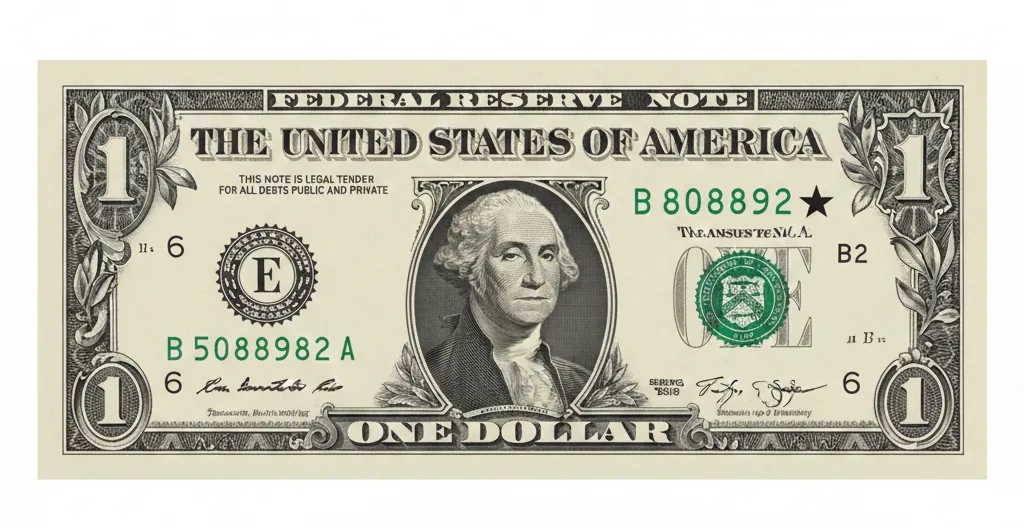
A replacement bill, or a Star Note, is a special bank note the government prints to take the place of a bank note that was printed badly, showing a special symbol on its serial number — the star symbol instead of a number or letter at the end.
Finding a Star Note
To know if a bank note is a Star Note, a person only needs to look closely at its serial number, finding this number printed in two places on the front side of the bill, being in the top-left corner and the bottom-right corner.
A normal serial number looks like a mix of letters and numbers, but if the bill is a replacement, the last letter or the last number in the serial number is changed to the five-pointed star symbol.
For example, a normal bill might have the number F12345678A, but the replacement bill from that same print run will have the number F12345678*, this star symbol being the only, but most important, thing making the bill special for collectors.
Checking the star’s place:
- On bank notes printed after the year 2003, the star symbol is always at the very end of the serial number.
- On very old bank notes printed before the 1910s, the star could be in a different place, for example, before the number, but talking about modern US currency (the main topic here), the star always stays at the end of the number.
It is important to say that Star Notes are not printed with the regular money, meaning the government prints them on special sheets of paper, preparing them in advance only for replacing the bills with errors.
Rarity
The Star Note and coin value for people who collect money comes mostly from how rare it is, which connects directly to the number of them printed, understanding that the fewer replacement bills printed in a certain series and for a certain Federal Reserve Bank, the higher the price for the note in the collector’s market.
- Why a small print number makes a difference: The most expensive Star Notes are the ones the government printed in a small number, meaning less than 640,000 pieces for that specific bill value and series, this number being a key point of measure for people who collect.
If the number of printed replacement bills for a certain series is much higher than this number, then people consider that note common, and it will not cost much more than the number printed on it unless it looks brand new.
- Finding information about the print number: Collectors use special public records, checking how many replacement bills the Bureau of Engraving and Printing has printed for every money value in every series for every Federal Reserve Bank, allowing them to know the exact number.
A bank note is called low print when:
- The number printed is between 1 and 640,000 pieces, these notes always having a high extra price.
- A person finds the note in general use, which is a very rare and exciting event because of its low print number.
Condition and Grading
The second important reason for changing the value is the physical state of the bank note, knowing that collectors will only pay the highest price for notes looking perfect and untouched, not having any damage, and at least checked by the best coin identifier app.
The system for checking the state of a bank note, or grading, uses a scale going from 1 to 70, with the number 70 meaning the bill is perfect and like new.
The effect on the price: Only the highest condition level is important for collectors, meaning a rare Star Note that is folded or dirty might cost only 5 to 10 times more than its face value, while that same note in perfect condition (UNC) can cost 50 to 100 times more.

The Series and the Money Value
The series of the bank note is the year printed on it (for example, Series 2017A), meaning that the older the series is, the harder it is to find a Star Note in good condition — most old notes have been worn out or destroyed over time, making older Star Notes (for example, Series 1928 or 1934) automatically cost more, even if their print number was not very low compared to today’s numbers.
Rare Mistakes and Special Finds
Sometimes Star Notes become part of even rarer finds that collectors want very much.
- Finding a Low Print Number Match: The most expensive finds are when a Star Note comes from a series where the government printed a very small number, for example, only a few thousand pieces.
This situation possibly happened because of the start of printing a new series, needing many bills to be replaced, and after fixing the problem, the printing continued with the usual large number of replacement bills, but that first, very small print number remains extremely rare.
Sometimes the bad bill is replaced by a Star Note that itself has a printing mistake, creating an “error on a replacement note”, a situation that is extremely rare and very expensive, examples of these mistakes being:
- When one side of the bill is printed out of its correct place compared to the other side
- Part of the picture or words is not on the bill
- The serial number is printed with a mistake or not fully printed
These notes having two special things are sold at auctions for very high prices, being unique pieces showing the rarity of a Star Note mixed with the rarity of a printing mistake.
How Collectors Find the Extra Price
- They make sure the bill truly has the star symbol.
- They look in the public records (using the series, money value, and Federal Reserve Bank) to find the number of these replacement bills printed, this being the most important step.
- They decide the bill’s score using the 1 to 70 grading scale.
- They look for similar bills sold before, helping them set the correct price for the current market.